How to Build an Emergency Fund from Zero (Step-by-Step)
An emergency fund is not optional. It is the foundation that makes every other financial goal possible.

According to Bankrate's 2025 Emergency Savings Report, 56% of Americans cannot cover an unexpected $1,000 expense from savings. That means a flat tire, an ER visit, or a broken appliance is enough to trigger a credit card spiral or a payday loan. This is not a poverty problem exclusively. Households earning $75,000-100,000 per year still had a 38% rate of being unable to handle a four-figure surprise According to Federal Reserve Report on Economic Well-Being 2023, this aligns with broader consumer-finance trends.
Building an emergency fund from zero feels overwhelming when you are already stretched thin. But the process is simpler than most financial advice makes it sound, and it starts smaller than you think.
Step 1: Define Your Target (But Start with $500)
The standard advice is three to six months of essential expenses. For a household spending $4,000 per month on necessities (housing, food, insurance, minimum debt payments, transportation), that is $12,000-24,000. If you have nothing saved, that number is paralyzing.
Ignore it for now. Your first target is $500. This is not a random number. Research from the Federal Reserve shows that $500 covers roughly 70% of the financial emergencies people actually experience: a car repair, a medical copay, an appliance replacement, or an urgent home fix. Getting to $500 eliminates most of the crises that send people to credit cards or payday lenders.
Once you hit $500, your next target is $1,000. Then one month of expenses. Then three months. Each milestone is a meaningful improvement in your financial resilience. Do not let the final goal prevent you from starting with the first one.
Step 2: Open a Separate Account
Your emergency fund cannot live in your checking account. It will get absorbed into daily spending without you noticing. Open a high-yield savings account (HYSA) at an online bank. In 2026, competitive HYSAs offer 4.5-5.0% APY with no minimum balance and no monthly fees.
The ideal HYSA for an emergency fund has three qualities: high yield (your money grows while sitting there), no withdrawal penalties (you need access when emergencies happen), and slight friction to access (not instant-transfer, so you are less tempted to dip in for non-emergencies). A 1-2 business day transfer time is actually helpful because it creates a natural cooling-off period for non-urgent withdrawals.
Step 3: Find the Money
This is where most guides become unhelpful by suggesting you "cut lattes" or "skip avocado toast." The actual approach is more systematic.
Audit subscriptions. The average American household spends $219 per month on subscriptions (streaming, apps, memberships, software). Cancel anything you have not used in the last 30 days. Do not negotiate or downgrade. Cancel. If you miss it in two weeks, resubscribe. Most people find $30-80 per month they do not miss at all.
Redirect one expense. Identify one recurring expense you can temporarily eliminate or reduce, and redirect that exact amount to your emergency fund via automatic transfer. Maybe it is the gym membership you replaced with home workouts. Maybe it is reducing your grocery budget by $50 per month through meal planning. One specific, concrete redirection.
Sell something. Most households have $200-500 worth of unused items: electronics you upgraded from, clothes you do not wear, furniture gathering dust. Sell them on Facebook Marketplace or eBay. This is not a sustainable income source, but it can jumpstart your emergency fund past the $500 mark quickly, which creates momentum.
Capture windfalls. Tax refunds, birthday money, work bonuses, cash back rewards, any unexpected income goes directly to the emergency fund until you hit your target. This is temporary. Once funded, you can redirect windfalls wherever you want.
Step 4: Automate the Contribution
Set up an automatic transfer from your checking account to your HYSA on every payday. Even $25 per paycheck ($50 per month) gets you to $500 in ten months. If you can swing $50 per paycheck, you are there in five months.
The automation matters because it removes the decision point. If you have to manually transfer money each month, you will find reasons to skip it. Automated transfers treat your emergency fund like a bill: it gets paid regardless of how you feel that day.
Combining automatic transfers with a savings challenge can accelerate the process. The challenge provides additional motivation and structure while the automatic transfer ensures a baseline contribution regardless.
Step 5: Protect the Fund
An emergency fund only works if you actually have it when the emergency happens. That means defining what counts as an emergency before one occurs.
Emergencies: Job loss, medical expenses, car repairs needed for commuting, critical home repairs (broken furnace, leaking roof), essential appliance failure.
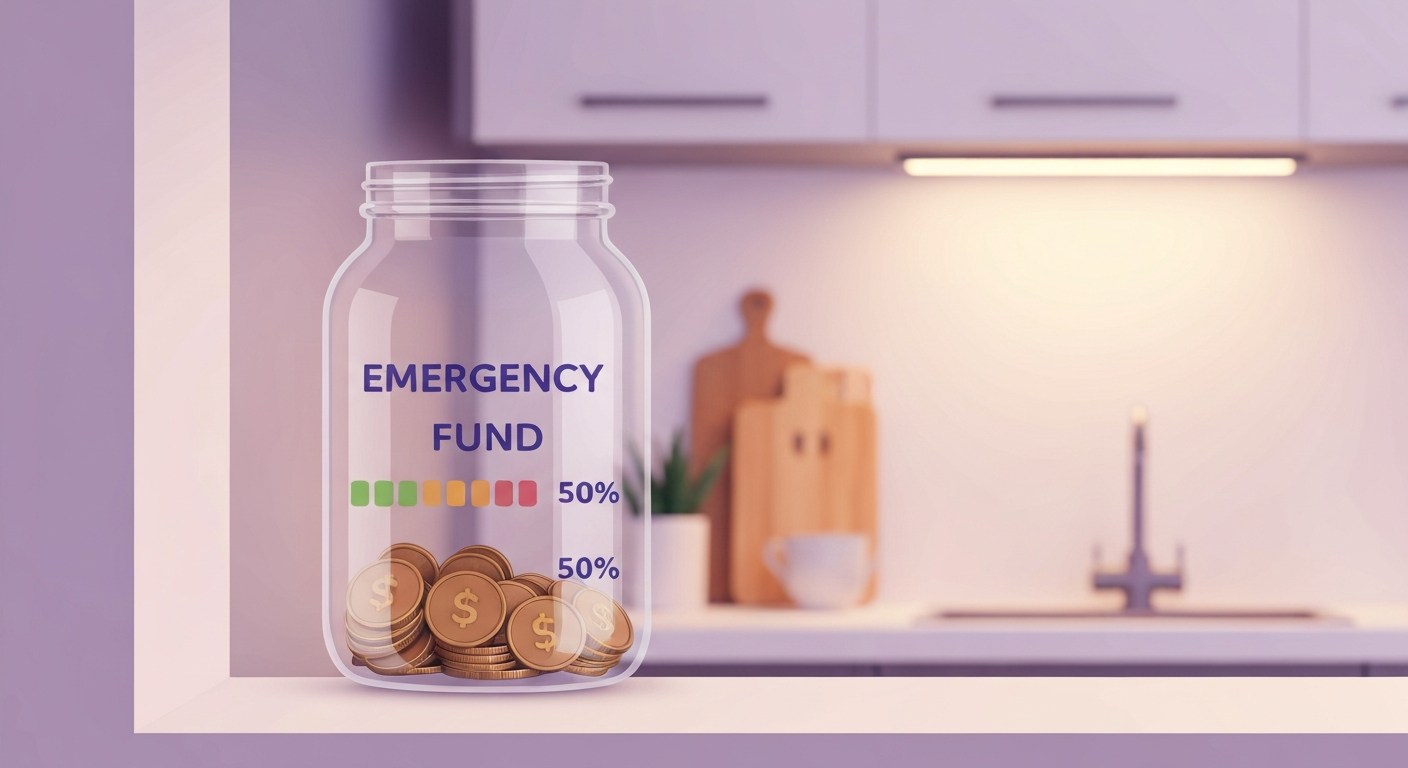
Not emergencies: Sales, vacations, holiday gifts, upgrades, cosmetic home improvements, routine car maintenance (budget for these separately). These are predictable expenses that should have their own budget categories.
Write down your personal definition of "emergency" and review it before making any withdrawal. This simple friction step prevents the fund from being depleted by non-emergencies disguised as urgent needs.
Step 6: Replenish After Use
Using your emergency fund is not failure. It is the fund doing its job. But you need to replenish it as quickly as possible afterward. When you make a withdrawal, temporarily increase your automatic contribution until the fund is back to its target level. If you normally contribute $50 per paycheck, bump it to $100 until you are whole again.
How Long Does It Actually Take?
Assuming a household with $4,000 in monthly essential expenses:
- $500 mini-fund: 3-6 months at $25-50 per week
- One month of expenses ($4,000): 10-20 months at $50-100 per week
- Three months ($12,000): 2-3 years at $100 per week
- Six months ($24,000): 4-5 years at $100 per week
These timelines look long. That is fine. The important thing is that you are making progress. At month six, you have $500-1,200 in savings that you did not have before. That is a material improvement in your financial resilience, even if you are still years from the "six months" ideal.
Tools That Help
AI budgeting apps can accelerate emergency fund building by automatically identifying saving opportunities you would not catch manually. An AI that notices you are paying for two streaming services with overlapping content, or that your car insurance could be cheaper with a different deductible, can find $50-100 per month in savings that go straight to the fund.
Gamified tracking helps with the motivation problem. Apps like kNexo turn your emergency fund progress into a visual mission with milestones and achievements. Watching a progress bar fill from 0% to 100% provides ongoing motivation during what is otherwise a slow, invisible process.
Frequently Asked Questions
Should I build an emergency fund or pay off debt first?
Build a $500-1,000 mini emergency fund first, then focus on high-interest debt. Without any emergency savings, unexpected expenses go on credit cards, which increases your debt. The mini-fund breaks this cycle. Once high-interest debt is gone, build the full three to six month fund.
Where should I keep my emergency fund?
A high-yield savings account (HYSA) at an online bank. Not in stocks (too volatile for money you might need tomorrow), not under your mattress (no growth and theft risk), not in CDs (withdrawal penalties). A HYSA gives you liquidity plus meaningful interest (4-5% in 2026) with FDIC insurance.
How much emergency fund do I need if I am single versus have a family?
Single with stable employment: three months of expenses is usually sufficient. Single with variable income (freelance, gig work): six months minimum. Family with one income: six months. Family with two incomes: three to four months (the second income provides some buffer). Adjust upward if you work in an industry with slow hiring cycles.
Is $1,000 enough for an emergency fund?
It covers most common emergencies (car repairs, medical copays, appliance replacements) but would not sustain you through job loss. Think of $1,000 as your starter emergency fund. It prevents the most common financial crises while you build toward the full three to six month target.
Ready to start building your emergency fund?
Join the kNexo waitlist for AI-powered savings goals and progress tracking.
Create free account